Camping with Dogs: A Holiday for the Whole Pack
Camping with Dogs: A Holiday for the Whole Pack. Camping is often one of the easiest ways to travel with a dog. You bring your own accommodation, spend plenty of time outdoors and often have nature close by. But a truly good dog-friendly holiday is not just about whether dogs are allowed. It is about finding places where both humans and dogs can actually enjoy themselves.
Published: 9/22/2026 • By CampApp
Download the app here
Want to continue in CampApp? Download the app to save favourites, discover more campsites and get a better overall experience.


More than simply allowing dogs
Camping with a dog sounds simple enough. You pack the caravan, motorhome or car, bring the dog bed, food bowl and lead, and off you go. In many ways, camping is one of the most dog-friendly ways to travel.
You have your own accommodation, avoid hotel corridors, can eat outside your vehicle and often have walks, woods, beaches or quiet roads nearby. For many dogs, that is far more natural than staying in a hotel in the middle of a city.
But dog-friendly camping does not only mean that dogs are allowed.
It means the place actually works for your dog. Is there shade? Good walking routes? Somewhere to cool down? Is the campsite calm enough for a dog that does not enjoy constant activity? Are the rules clear so you know where dogs are welcome?
Those details often decide whether the holiday feels relaxed or becomes a series of small problems to solve.
Choose the campsite with your dog in mind
When looking for a campsite, it is easy to start with the human wish list. Close to the beach, a nice restaurant, a playground, cycling paths, good facilities and convenient access to day trips.
But if the dog is coming too, it needs to be part of the planning.
A campsite that looks perfect on paper can be difficult if there is no shade, nowhere good to walk or a nearby beach where dogs are not allowed during summer. At the same time, a simpler nature campsite can be wonderful if it has calm walking routes, enough space and shaded pitches.
The question is not only whether your dog can come along.
The question is where your dog can be, how everyday life at the campsite works and whether the place suits your dog.
Walks matter more than you think
For many dog owners, the most important feature is not a dog shower, an agility area or a dog symbol in the booking system.
It is the walks.
Are there good places to walk in the morning? Can you take a longer route in the evening? Are there forest paths, coastal walks, gravel roads or nature trails nearby?
That makes a huge difference. A camping holiday with a dog becomes much easier when every walk does not feel like a project.
This is especially true if you are staying for more than one night. After a while, you will want more than the same short loop past the bins and back.
Shade, water and rest
The biggest risk when camping with a dog is often not rain.
It is heat.
A sunny pitch can quickly become hot, especially if it is open with no trees or natural shade. Cars, awnings and caravans can also become much warmer than expected.
That is why shade can be almost as important as electricity and water for many dog owners. An awning, tarp, parasol or a pitch with trees can make a big difference. Your dog should always have access to water and a calm place to rest away from children, bicycles, other dogs and people passing by.
A dog on holiday often experiences far more than it does at home. New smells, new people, new dogs and new places all take energy. Even the most social dog needs proper breaks.
A beach is not always a dog beach
Many campsites are close to the sea, lakes or swimming areas. That does not automatically mean dogs are allowed there.
Rules for dogs on beaches vary between municipalities and can be especially strict during the bathing season. Sometimes there are designated dog beaches. Sometimes dogs are allowed in certain areas. Sometimes they are not allowed at all during summer.
The safest option is to ask at reception or check local information before heading to the beach with a towel and an excited dog.
A nearby dog-friendly swimming spot can be worth a lot.
Not only for the dog, but for the whole holiday feeling.
The lead is not just a rule
At many campsites, dogs must be kept on a lead, and that makes sense.
Campsites are full of people, children, bicycles, dogs, barbecues, outdoor tables and small spaces where many guests need to get along. Even a friendly dog can cause stress if it approaches someone who is afraid, allergic or has a dog that does not want to greet others.
The same applies in nature. During spring and summer, wildlife is especially sensitive, and many nature reserves and national parks have specific rules. Near grazing animals, it is always important to keep full control.
Even if your dog usually comes when called, a camping holiday is rarely the right time to take chances.
A lead or long line may sound limiting, but used well it provides both freedom and safety.
Children and dogs in a small space
Camping with both children and dogs can be wonderful. The children find holiday friends, the dog gets to join in and the days are often full of outdoor life.
But at a campsite, many children and many dogs meet in a relatively small area. It works best when adults help set the tone.
Children need to know that they should always ask before greeting a dog. The dog needs its own place where it can rest undisturbed. And dog owners need to remember that not all children are used to dogs.
A dog resting in the shade outside the caravan can look very tempting to a child who loves animals. But for the dog, that may be a much-needed break after a long day.
Clear family rules make the holiday easier for everyone.
Children, dogs and neighbours included.
Plan your day trips wisely
Camping with a dog works best when the dog is part of the plan from the beginning.
Dogs are not always allowed in museums, amusement parks, restaurants, bathing areas or certain nature reserves. And on warm days, leaving the dog in the car is not a solution.
That is why it is wise to think through your excursions before you are already standing in the car park realising the dog cannot come inside.
Some days are perfect for dog-friendly walks, nature trails, outdoor cafés or swimming spots where dogs are welcome. Other days may require someone to stay at the campsite with the dog.
It may sound a little less spontaneous.
But it makes the trip much calmer.
When the dog makes camping better
For many adults and older couples, the dog is one of the reasons camping works so well.
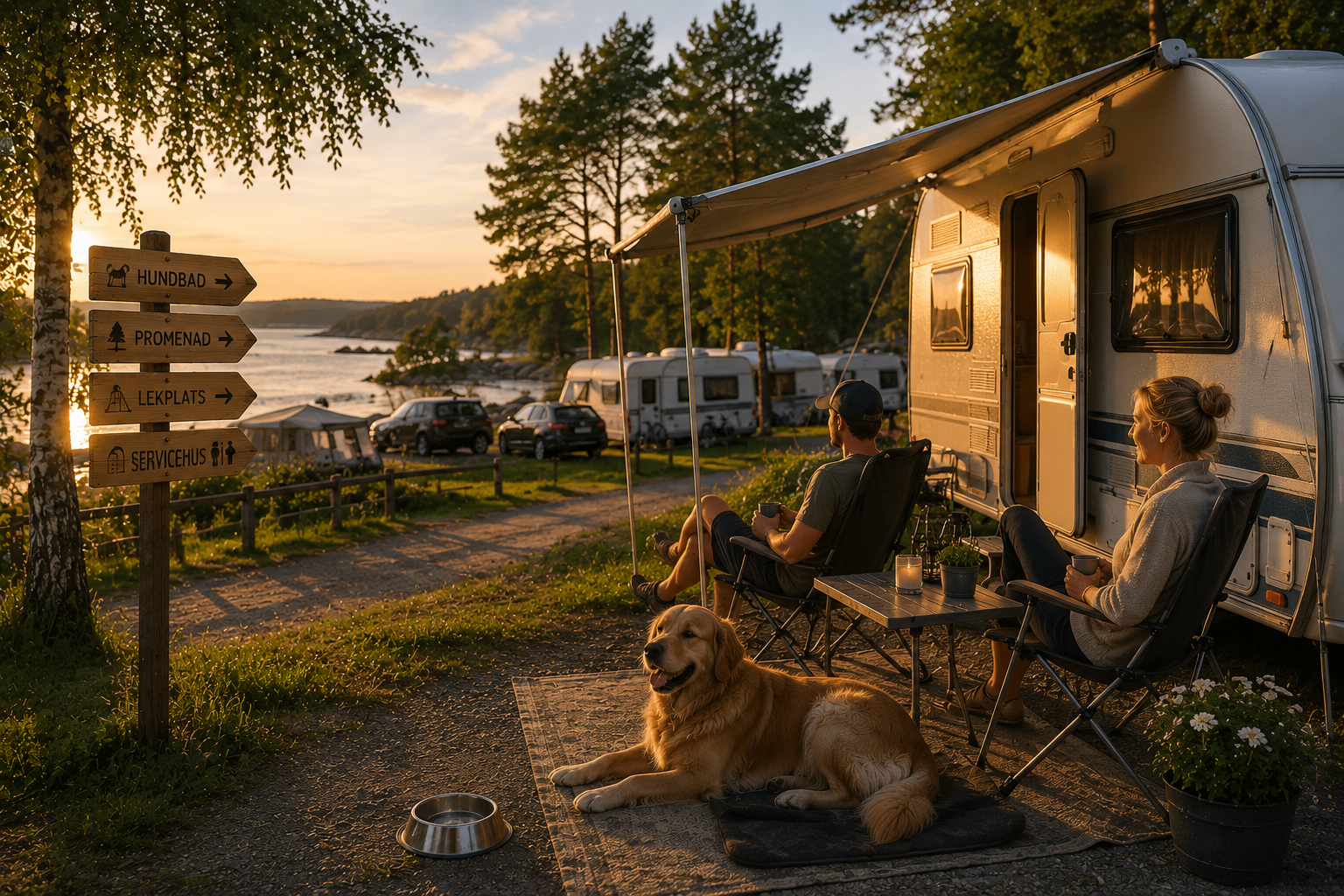
You can choose calmer places, take long morning walks, eat outside your caravan or motorhome and let the dog have its own bed, routines and safe place. It becomes a type of holiday where the dog does not just come along, but genuinely fits in.
There is something very appealing about that image.
Morning coffee outside the vehicle. The dog resting in the shade. A walk before the day has properly begun. Maybe an excursion, maybe just a quiet day on site.
For many people, that is exactly what a holiday should feel like.
Pack for your dog's holiday too
A good dog-friendly holiday often starts with the packing.
Lead, spare lead, long line, harness, food bowl, water bowl, dog food, waste bags and towels are obvious basics. But it can also be useful to bring a collapsible water bowl for excursions, tick remover, first aid kit, medication, cooling mat or cooling vest during hot periods, and a blanket or bed that smells like home.
If you are travelling outside your own country, your dog's documents need to be planned as carefully as your ferry tickets. Check pet passport requirements, identification, rabies vaccination and any country-specific rules well in advance.
It may not be the most exciting part of planning.
But it is far better than discovering a problem at the border.
A holiday for the whole pack
Camping with a dog can be simple, free and truly enjoyable.
But the best dog-friendly holidays are not only about finding a campsite where dogs are allowed. They are about finding a place where the dog can actually feel good.
Good walks. Shade. Water. Clear rules. The right amount of activity. And people who remember that dogs need a holiday in their own way too.
When it works, camping with a dog can be one of the best ways to travel.
Not because everything is perfect.
But because the whole pack gets to come along.
Related links
Read also
Let the Place Decide Dinner
Camping is all about freedom. The freedom to stop where the view is beautiful, take a detour when a handmade sign catches your eye or discover a small village you had never planned to visit. So why not let that same freedom shape your meals? Instead of planning every dinner before you leave home, let the place you're visiting decide what ends up on your plate.
Camping with Teenagers: Let the Holiday Grow Up a Little
When children become teenagers, camping holidays change. The playground may no longer be enough, and yet another “cosy little outing” can be met with a look that says everything. But with more involvement, more flexibility and some respect for personal space, camping with teenagers can still be really good.
First Time in a Motorhome: Does Everything Really Have to Be Level?
A first motorhome trip is often a mixture of freedom, excitement and mild panic. You imagine drinking coffee beside a peaceful lake, but soon find yourself at a motorhome stop wondering whether the vehicle is leaning, how to empty the grey water and why the power cable is two metres too short. Relax. You do not need to know everything, buy everything or park perfectly level on your first attempt.