First Time in a Motorhome: Does Everything Really Have to Be Level?
First Time in a Motorhome: Does Everything Really Have to Be Level?. A first motorhome trip is often a mixture of freedom, excitement and mild panic. You imagine drinking coffee beside a peaceful lake, but soon find yourself at a motorhome stop wondering whether the vehicle is leaning, how to empty the grey water and why the power cable is two metres too short. Relax. You do not need to know everything, buy everything or park perfectly level on your first attempt.
Published: 8/25/2026 • By CampApp
Download the app here
Want to continue in CampApp? Download the app to save favourites, discover more campsites and get a better overall experience.


Welcome to freedom and a surprising number of accessories
It is easy to romanticise your first motorhome trip. You will wake beside a lake, open the door to the morning sun and casually say that you will simply see where the road takes you. Perhaps you will make coffee barefoot while a bird sings somewhere nearby at an appropriately peaceful volume.
Then reality arrives.
You are standing at your first motorhome stop trying to decide whether the vehicle is leaning slightly or dramatically. Someone is looking for the adapter for the power cable. Someone else is asking whether the gas is on. One cupboard will not open because a chair is in the way, and four newly purchased accessories are lying in the rear storage area without anyone knowing exactly what they are for.
This is completely normal.
The motorhome world is full of people who look as though they were born holding levelling ramps. They reverse perfectly into the pitch on the first attempt, extend the awning without reading the instructions and connecting electricity with the confidence of professional engineers.
Ignore them. They were beginners once too. Or they are simply very convincing actors.
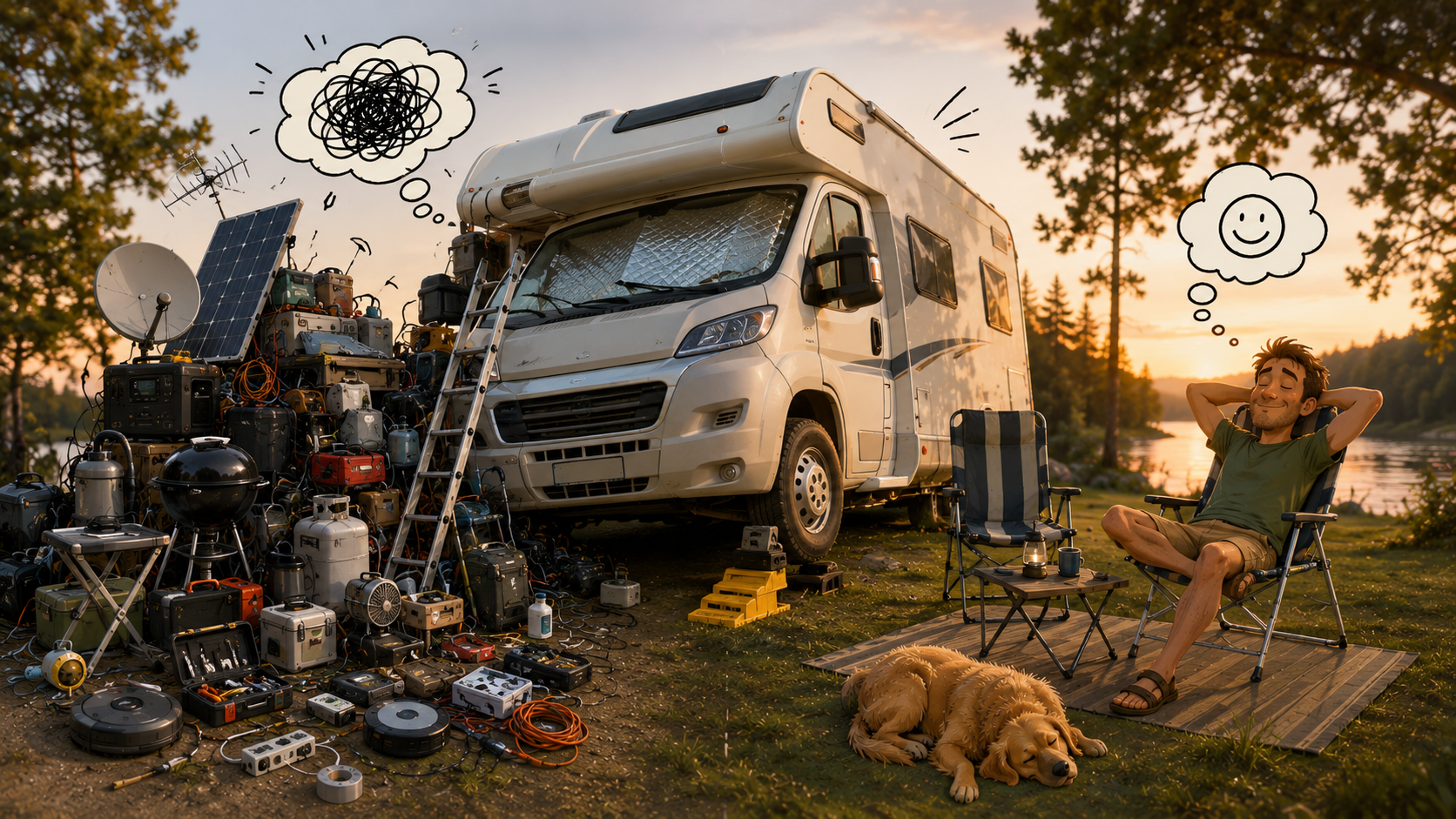
Do not buy the entire camping shop before your first trip
Motorhome accessory shops are dangerous places. You go in to buy a power cable and leave with a folding washing-up bowl, special non-rattling cups, three clever hooks, an outdoor mat, a small stool and something described as a universal organiser.
Everything looks useful in the shop. Everything also appears to solve a problem you did not know existed.
But your first trip does not need to begin with buying every product ever created for mobile living. Start with the essentials and allow the rest to reveal itself over time.
A proper camping power cable, basic levelling ramps, a way to collect or fill water, gloves for emptying waste, a small tool kit, a torch, first aid supplies and working fire safety equipment will take you a long way. If you plan to use the toilet, you will also need to understand and carry the right products for that system.
Everything else can wait.
After your first trip, you will know whether you genuinely needed a longer hose, another table or a clever storage solution. That is much better than discovering that your payload disappeared somewhere between the folding bin and the third frying pan.
Slightly uneven is often level enough
Levelling ramps are useful. Your sleep, refrigerator and frying pan will all appreciate a reasonably level vehicle. But it is easy to become obsessed with achieving perfection.
You drive onto the ramp. Reverse off again. Move it three centimetres. Drive up once more. Someone stands outside gesturing with the intensity of a spacecraft docking operation.
Eventually, the motorhome may be half a degree straighter, but the entire family is irritated and the neighbours have received free evening entertainment.
It rarely needs to be that complicated. If the coffee remains in the cup, the saucepan stays on the hob and nobody rolls out of bed during the night, you are probably close enough.
Park as level as reasonably possible, make sure the vehicle is secure and continue with the holiday. Especially for a one-night stop, there is no reason to turn setting up into an engineering thesis.
Slightly uneven is still level, at least until the pasta water boils on only one side of the pan.
A large vehicle does not always have a large payload
A motorhome may look like a small apartment on wheels, but that does not mean you can load it like a small apartment.
Many motorhomes have a maximum authorised mass of 3,500 kilograms and can be driven on a standard car licence in many countries. The problem is that the difference between the vehicle's unladen or running weight and its permitted maximum weight can be surprisingly small.
Passengers have weight. Water has weight. Gas bottles, food, clothing, outdoor furniture, barbecues, bicycles and tools all have weight. Electric bicycles can be impressively heavy, especially once you have added two gas bottles, a full refrigerator and a box of things that might be useful.
A full fresh-water tank alone can use a considerable part of the available payload. It may therefore be sensible to carry only the amount of water you need for the journey and fill up after arrival.
The best advice is simple: weigh the motorhome when it is packed for travel. Not empty on the driveway and not through a theoretical calculation at the kitchen table. Weigh it with passengers, water, food, bicycles and everything that will actually travel with you.
Weight may not be the most romantic part of motorhome life, but understanding it can prevent very avoidable problems.
Your licence is determined by numbers, not appearances
The motorhome's length, number of beds or luxurious interior does not determine which driving licence you need. The vehicle's maximum authorised mass and your licence category do.
In Sweden and much of Europe, the basic limit for a standard category B licence is a vehicle with a maximum authorised mass of 3,500 kilograms. Heavier motorhomes may require another category, such as C1. There may also be exceptions depending on when your licence was issued and how the vehicle is registered.
Do not rely on rumours about future rules or something a stranger wrote in a social media group several years ago. Check the registration documents, your licence category and the current official rules for the countries where you will drive.
It is much better to clarify this at home than during a roadside inspection far from the peaceful lake you imagined.
Water is simple until it has to come out again
Fresh water is the water you fill and use. Grey water is the water from sinks, washbasins and showers. Toilet waste is normally stored in a separate cassette or tank.
None of this is particularly complicated once you understand the system, but the first visit to a service point can feel like a practical examination where everyone else already knows the answers.
Learn where the controls and outlets are before leaving home. Find out how to fill the fresh water, where the grey water drains and how to remove and empty the toilet cassette. Wear gloves, use designated disposal points and leave the area as you would like to find it.
Water is wonderful until you realise that you must both carry it around and eventually dispose of it correctly.
The good news is that it quickly becomes routine. After a few attempts, you too will look confident while the next beginner studies the service point and tries to work out which hatch does what.
Gas and electricity require respect, not panic
Gas is commonly used for heating, cooking and sometimes refrigeration. A properly installed and maintained system is not something to fear, but it should be treated with respect.
Check that hoses and connections appear undamaged and follow the vehicle manufacturer's instructions. Gas bottles must be secured and stored in the correct position. Make sure smoke alarms, fire extinguishers and any carbon monoxide alarm are present and working.
Hook-up electricity is not especially mysterious either. Use a cable intended for campsite use and check the amperage available at the pitch. On a low-amperage supply, using a kettle, electric heater and several other appliances at the same time may be more ambition than the system can handle.
If you use a cable reel, unwind it properly. And before driving away, remember to disconnect the power cable, even if it has become surprisingly well camouflaged in the grass.
You are still driving a small house
The steering wheel and pedals may feel familiar, but a motorhome is wider, longer, taller and heavier than a normal car. This becomes especially noticeable at fuel stations, in roundabouts, on narrow roads and when entering a cramped campsite.
Write down the motorhome's height, width and length and keep the figures easy to find. Height is particularly important around bridges, tunnels, car parks, branches and roof overhangs.
Remember the rear overhang as well. The house follows you when you turn, and the rear can swing in the opposite direction from the front.
When reversing, it is often wise to ask a passenger to get out and guide you. Agree on clear signals beforehand and make sure the driver can always see the guide. A useful safety rule is that the driver stops immediately if the guide disappears from view.
And whenever you are unsure, stop and get out to look.
That is not failure. It is considerably smarter than continuing on instinct and later discovering that the bicycle rack and a post attempted to occupy the same space.
Make the first overnight stop easy
Your first night does not need to be on a remote beach beneath the midnight sun with mountain views and no other people for fifty kilometres.
A straightforward campsite or official motorhome stop with easy access, electricity, water, waste facilities and other travellers nearby is often a much better choice. Arrive at a sensible time so you do not have to learn every system in darkness and rain.
It can also be wise to make the first journey reasonably close to home. That allows you to test how the motorhome works, how well you sleep, what you missed and which items merely travelled around unused in the cupboards.
The first trip is not a final examination. It is a test run with coffee.
And if something goes wrong, there is often someone nearby who is happy to help. Motorhome travellers are generally friendly, especially when given the opportunity to explain how something works.
Pack for a weekend, not the end of civilisation
A motorhome feels spacious until you start packing as though every destination on the route lacks shops and human settlement.
Bring clothing for the actual weather, simple food, medication, chargers, basic tools, the cables and hoses you need and a sensible amount of outdoor furniture. Something for rain and mosquitoes is rarely a bad idea.
You probably do not need your entire home kitchen. Three frying pans are rarely essential. Forty-eight spices can stay behind. Spare parts nobody knows how to use mainly contribute weight.
There is a point where sensible packing turns into operating a mobile hardware shop. Try to stop before reaching it.
Check everything before moving
It is surprisingly easy to forget something when leaving a pitch, so a simple departure routine is extremely useful.
Make sure the power cable is disconnected, the awning is retracted, the step is in and the levelling ramps have been collected. Close windows, roof vents, cupboards and drawers. Secure the refrigerator, bicycles and other loads. Check the gas according to the vehicle's instructions and make sure the water level is appropriate.
Empty grey water and the toilet when necessary, and walk around the vehicle once before driving away.
Look upwards too. Roof vents have a remarkable ability to become invisible as soon as the driver sits behind the wheel.
And remove the coffee cup from the table. It may not be the most important road-safety point, but it matters for the upholstery and the soul.
Your first trip does not need to be perfect
Everyone has been a beginner. Everyone has stood at a service point and tried to look as though they knew exactly what they were doing. Everyone has forgotten something, parked slightly unevenly or bought an accessory that remained unused for years.
That is part of motorhome life.
Your first trip is not about doing everything perfectly. It is about learning the vehicle, developing routines and finding out what you genuinely need.
Do not buy the entire camping shop.
Do not pack for the apocalypse.
Understand the weight, licence, gas and waste systems.
Park reasonably level.
And remember that freedom is not measured by the number of gadgets in the storage compartment.
It is the ability to wake up, make coffee and decide where you would like to go next.
Related links
Read also
Let the Place Decide Dinner
Camping is all about freedom. The freedom to stop where the view is beautiful, take a detour when a handmade sign catches your eye or discover a small village you had never planned to visit. So why not let that same freedom shape your meals? Instead of planning every dinner before you leave home, let the place you're visiting decide what ends up on your plate.
Camping with Dogs: A Holiday for the Whole Pack
Camping is often one of the easiest ways to travel with a dog. You bring your own accommodation, spend plenty of time outdoors and often have nature close by. But a truly good dog-friendly holiday is not just about whether dogs are allowed. It is about finding places where both humans and dogs can actually enjoy themselves.
Camping with Teenagers: Let the Holiday Grow Up a Little
When children become teenagers, camping holidays change. The playground may no longer be enough, and yet another “cosy little outing” can be met with a look that says everything. But with more involvement, more flexibility and some respect for personal space, camping with teenagers can still be really good.