Camping with Teenagers: Let the Holiday Grow Up a Little
Camping with Teenagers: Let the Holiday Grow Up a Little. When children become teenagers, camping holidays change. The playground may no longer be enough, and yet another “cosy little outing” can be met with a look that says everything. But with more involvement, more flexibility and some respect for personal space, camping with teenagers can still be really good.
Published: 9/4/2026 • By CampApp
Download the app here
Want to continue in CampApp? Download the app to save favourites, discover more campsites and get a better overall experience.


When the camping holiday changes
Camping with small children is often about fairly clear things. Is there a playground? Is the beach child-friendly? Can they cycle safely? Is there ice cream within a reasonable distance from the pitch?
When children become teenagers, the playing field changes a little.
Suddenly, the playground may no longer be impressive. The kids' club is definitely not relevant. That little forest walk you think sounds “cosy” may be met with a sigh loud enough to travel across the entire campsite.
That does not mean teenagers do not enjoy camping. But the camping holiday often needs to grow up a little with them.
For a teenager, a holiday is rarely just about where the family is staying. It is also about freedom, privacy, interests, friends, screens, food, pace and the possibility of not joining every single family activity all the time.
And honestly, that is quite reasonable.
Involvement does not mean veto power
One of the most important things when camping with teenagers is letting them influence the holiday for real. Not by asking “what do you want to do?” five minutes before everything is already decided, but by actually giving them room to be part of the planning.
That does not mean the teenager gets to run the entire trip.
Parents still need to set the framework. Budget, safety, distance, number of days and what works for the whole family are still adult responsibilities. But within those boundaries, there is often plenty the teenager can influence.
It might be an activity, an excursion, a restaurant, a beach day, a museum, a city break or a day when nothing much happens at all.
Involvement does not mean they get to decide everything. It simply means the holiday is not planned as if the teenager were luggage.
Not all teenagers want the same holiday
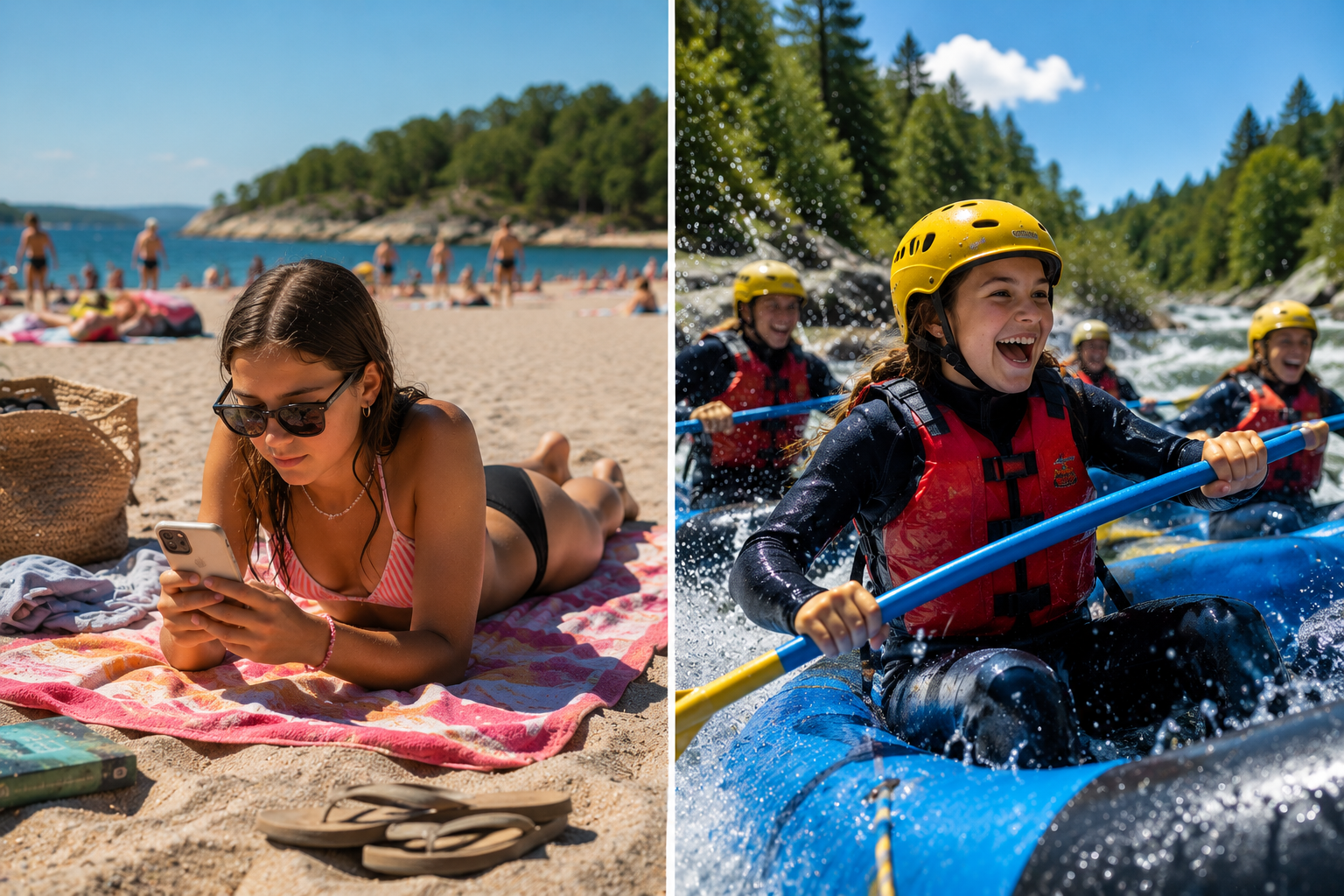
It is easy to assume that teenagers need action. Rafting, ziplining, mountain biking, climbing, surfing and high ropes courses. And for some, that is absolutely right. One really good activity can lift an entire trip.
But not all teenagers are looking for adrenaline.
Some want to spend the whole day on the beach, swim occasionally, listen to music and do as little as possible. Others want to shop, fish, take photos, work out, read, play games, go to concerts, explore second hand shops or visit a very specific museum that happens to hit exactly the right part of their brain.
This is where adults sometimes need to let go of their own idea of what a “good outing” looks like.
A museum does not have to appeal to everyone to work. Sometimes the narrow focus is exactly what makes it interesting. Classic cars, aircraft, military history, gaming, design, music, football, art or anything else that actually connects with your teenager.
It does not have to be perfect for the whole family.
It just has to matter to someone.
Sometimes the beach is the whole plan
For adults, it can feel almost provocative to travel somewhere and then not “make the most of it”.
You are already there. Should you not see something? Do something? Experience something?
But sometimes a teenager's best holiday plan is to have no plan at all.
A whole day on the beach may be exactly what they need. Not because the beach is unique, but because the day has no schedule. There is no next stop, no parking to find, no entrance fee and no adult saying “let's just walk a little bit further”.
That can be hard to accept if you like filling a holiday with experiences. But recovery is also part of a holiday. Especially for teenagers coming from school, training, social pressure, screens, expectations and late nights.
Sometimes the best thing you can do is leave the day a little empty.
Personal space is not a failure
It is easy to interpret a teenager's need for personal space as disinterest.
But teenagers can love their family and still need a break from it. That is not a personal failure. That is being a teenager.
At a campsite, this can become especially obvious because everyone lives close together. The caravan is small, the awning is shared and everyone hears when someone opens a bag of crisps. A personal zone can make a big difference.
It might be a separate sleeping area, a small tent, headphones, a chair in the shade, a book, a bike ride, a walk or some time at the beach without the rest of the family following along.
That does not mean the family holiday is ruined. Quite the opposite. It may be exactly what makes it work.
Decide which parts of the day are truly shared. Dinner. One excursion. Evening snacks. A beach day. But allow other parts to be looser.
Nobody needs to be socially available all the time.
The screen is not the enemy of camping
It is almost impossible to talk about teenagers without talking about screens.
And yes, it can be frustrating to travel far, park by the sea and create the perfect holiday setting only to find your teenager staring at a phone.
But the phone is not automatically the enemy of camping.
It can also be a camera, map, weather app, music player, contact with friends, restaurant guide and a way to find the next activity. The question is perhaps not whether screens should exist, but when they get in the way of what you actually want to do together.
Many families do better with a few clear but reasonable rules than with constant low-level nagging.
Maybe screens are fine during rest and personal time. Maybe meals are screen-free. Maybe sleep is more important to protect than every moment during the day.
The important thing is not turning every phone moment into a conflict.
There are more interesting things to argue about on holiday. Like who forgot to pack the beach towels.
Choose a campsite for the age your children actually are
A campsite that was perfect when the children were five and seven is not automatically perfect when they are thirteen and fifteen.
With teenagers, a “good location” may mean something different. It is not only about being close to the playground, but about whether there is something there for them too.
A beach or swimming area is often good. The possibility to cycle or walk independently can be even better. Proximity to a town, public transport, a skatepark, gym, running trail, paddling, climbing, go-karting, museum or café can matter more than you might expect.
And however unromantic it may sound, Wi-Fi or decent mobile reception can actually affect the mood.
That does not mean the whole holiday should be built around the teenager. But if you want them to enjoy it, it helps to choose places where their world fits too.
Not everyone has to do everything
One of the most liberating realisations with older children is that the family does not always have to move as a single unit.
Not everyone has to join everything.
One parent can take one child to a museum while the other goes swimming with the rest. A teenager may sometimes stay at the campsite if it is safe and reasonable. Someone can go for a bike ride. Someone else can read in the shade.
That does not mean splitting the family.
It means allowing the holiday to work for more people.
A successful holiday with teenagers does not have to mean everyone doing everything together. It can mean everyone getting something they actually want to do.
Make it easy to say yes
Teenagers can say no almost automatically. Most parents who have tried to sell in a “nice little outing” with too much enthusiasm know this.
Concrete options often work better.
Do you want to choose where we have lunch in town?
Should we go paddling or visit a museum tomorrow?
Do you want to come to the beach or stay here and read?
Do you want to plan the route to the next stop?
Do you want to find somewhere for dinner tonight?
It is easier to say yes when the question is not too big and when the answer actually matters.
Giving teenagers real responsibility can also make a big difference. Not pretend responsibility, but actual tasks. Checking opening hours. Booking tickets. Finding the next swimming spot. Making a playlist. Planning a meal. Choosing an activity.
That is often much better than simply saying “help out”.
Accept that appreciation may arrive later
Perhaps the most frustrating thing about travelling with teenagers is that you do not always get applause in real time.
They may look bored and still remember the trip fondly later. They may sigh through an entire excursion and then mention it as a good memory months afterwards. They may say “it was okay” in a tone that actually means “I had quite a good time but I am not giving you that victory right now”.
That is part of it.
Not all appreciation arrives while you are standing there with the backpack, sunscreen and map.
Sometimes it comes much later.
And sometimes it does not come at all, but the memory is there anyway.
Camping with teenagers needs to be different
Camping with teenagers is less about entertainment and more about negotiating a holiday where everyone gets to be part of it.
It might mean a day of rafting. A day on the beach. A niche museum. A city break. An evening meal together. An afternoon where nobody does the same thing.
It does not need to be perfect.
But it probably needs to be more flexible than when the children were small.
When children grow older, the camping holiday needs to grow up a little too. And if you manage that, it can still be exactly what camping does best.
A place where the family gets time together.
But also enough space for everyone to be themselves.
Read also
First Time in a Motorhome: Does Everything Really Have to Be Level?
A first motorhome trip is often a mixture of freedom, excitement and mild panic. You imagine drinking coffee beside a peaceful lake, but soon find yourself at a motorhome stop wondering whether the vehicle is leaning, how to empty the grey water and why the power cable is two metres too short. Relax. You do not need to know everything, buy everything or park perfectly level on your first attempt.
The History of the Caravan – How a Home on Wheels Became Part of Scandinavian Life
A caravan is much more than just a vehicle. For many people, it is a holiday cottage on wheels, a place where the holiday begins the moment it is hitched to the car. But where did it all start? From exclusive horse-drawn touring wagons to becoming a symbol of freedom, family holidays and the Scandinavian love of both adventure and comfort, the caravan has travelled a remarkable journey.
You do not actually have to stay in Gothenburg to experience Gothenburg
It is easy to assume that a camping trip to Gothenburg means staying as close as possible to the city centre. But for many campers, that is not always the best choice. If Gothenburg is only one or two day trips during your holiday, staying a little further away can give you the sea, nature or the archipelago while still keeping the city within reach.