The unwritten rules of camping: be decent and enjoy yourself
The unwritten rules of camping: be decent and enjoy yourself. Every campsite has rules about barriers, dogs, barbecues and quiet hours. But there is another set of rules as well. The ones that are never written down yet somehow get passed from one generation of campers to the next.
Published: 6/18/2026 • By CampApp
Download the app here
Want to continue in CampApp? Download the app to save favourites, discover more campsites and get a better overall experience.


Camping is a small community
There are rules at campsites.
They are often posted on a sign at reception, included in the booking confirmation or found on a page called something like "Good to Know". They cover check-in, check-out, dogs, barbecues, service buildings, quiet hours and all the other things that help a campsite run smoothly.
Those rules are good. They are necessary.
But then there are the rules that are never written down anywhere. The ones that most people seem to understand surprisingly quickly. The unwritten rules of camping.
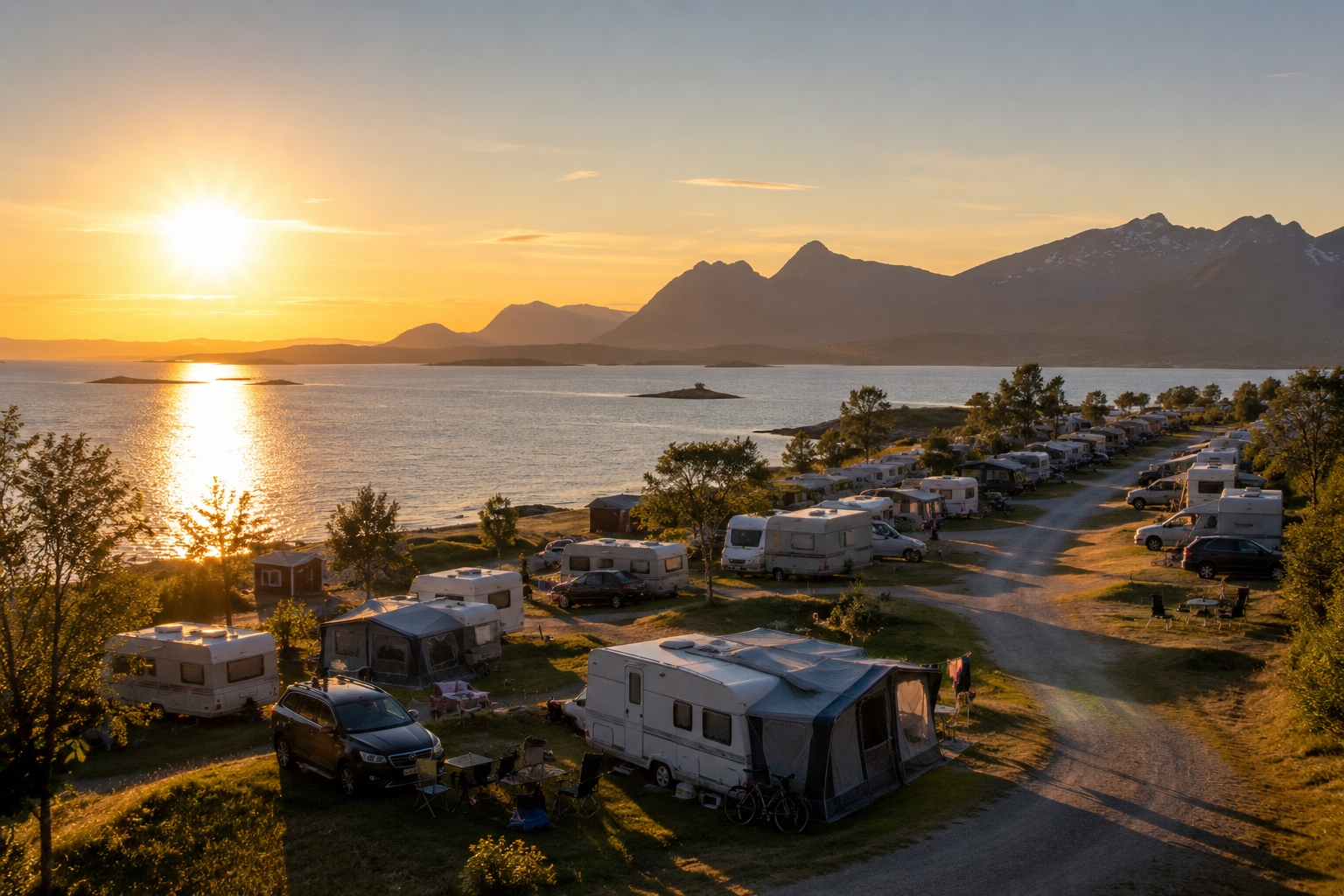
One of the things that makes camping special is also what makes campsite life a little different. People live close together. At home we have walls, hedges, fences and driveways that create distance between neighbours. At a campsite there may only be a few metres between your morning coffee and someone else's sleeping area.
You sit there with a cup of coffee in your hand while your neighbour heads for the service building with a toothbrush in their mouth. Someone is frying bacon. Someone is inflating a pool toy. Someone is looking for their child. Someone is trying to reverse a caravan into place while the entire neighbourhood pretends not to watch.
Camping is private and public at the same time.
You have your own space, but at the same time you share a great deal with others. The sounds, the air, the pathways, the smell of barbecues, the service building, the children's games and those long summer evenings when everyone seems to be outside at once.
That is why the unwritten rules exist.
Not because anyone wants to make a holiday feel formal.
But because camping works best when people show a little consideration for one another.
A camping pitch is a temporary living room
One of the most fundamental unwritten rules is also one of the simplest.
Don't walk through someone else's pitch.
It may seem like an insignificant shortcut on the way to the service building or playground, but for the person sitting there with their coffee it can feel very much like someone has just walked straight through their living room.
Because that is exactly what a camping pitch becomes for a few days or weeks.
A temporary living room.
That is where the chairs are. That is where the blanket lies. That is where the swimwear dries. That is where the family eats breakfast. That is where the dog sleeps in the shade, and perhaps where the barbecue is waiting for the evening meal.
Most campers have absolutely no problem with people saying hello or stopping for a chat. Quite the opposite. Camping is often better when people are open and sociable.
But there is still an invisible boundary that is worth respecting.
Sound travels further than you think
Camping should feel alive.
Children should laugh. People should talk. Someone will drop a saucepan on the ground. A dog will bark. Someone will grumble about an awning that behaves nothing like it did in the instruction video.
That is all part of camping.
But there is also a middle ground between life and chaos.
At a campsite, sound travels much further than you think. A Bluetooth speaker that feels perfectly reasonable at your own table can become the evening's headline act three pitches away. A conversation that seems perfectly normal at midnight may sound considerably louder to the neighbour trying to get their children to sleep.
Most campsites have quiet hours, but good camping manners are not really about the clock. They are more about reading the surroundings and remembering that everyone else is there to enjoy their holiday too.
A little common sense goes a very long way.
The ball is magical, but it needs the right place
Children and camping belong together.
And children playing definitely belong together with camping.
There should be cycling, jumping, running, making new friends and playing ball games. A campsite where children are never seen quickly becomes a rather boring place.
And if there is one thing that works at almost every campsite, it is a ball.
A ball is almost magical.
One child starts kicking a ball around on a grassy field. Then another child joins in. Then another. Before long there is a football match taking place where nobody really knows who owns the ball anymore and the rules seem to change every five minutes.
It is fantastic.
But the same ball that creates new friendships on an open field can create a very different atmosphere between caravans, cars and awnings.
That is why one of the best compromises in camping is very simple.
Let children play, but help them find the right place to do it.
If there is a football field, a large grassy area or a stretch of beach meadow, the problem is usually solved immediately.
Help or look away
There is a special kind of vulnerability that comes with reversing a caravan into a pitch.
You may have been driving for hours. The children need the toilet. Someone is hungry. Everyone is tired. The neighbours already seem perfectly settled while you are trying to fit your caravan into a space that suddenly feels much smaller than it looked on the booking page.
And everyone is watching.
That is when one of camping's finest unwritten rules comes into play.
Either offer help.
Or look away.
Standing with your arms crossed and treating the manoeuvre as evening entertainment does not count as helping.
The wonderful thing is that the camping community is still remarkably generous. If someone needs to borrow a tool, get help with an awning or simply needs an extra pair of hands when something refuses to cooperate, there is usually a helpful neighbour nearby.
It all comes down to consideration
Most unwritten camping rules can be summed up in the same way.
Clean up after yourself in the service building.
Drive slowly between the caravans.
Think twice about where your barbecue smoke is heading.
Remember that not everyone loves your dog quite as much as you do.
Small things.
But it is often the small things that determine whether a campsite feels pleasant or not.
Camping should still feel like camping. It should be a little messy, a little sandy, a little untidy and full of life. Children should be free to cycle around. Barbecues should be lit. People should laugh and spend time together.
But camping is at its best when people help each other enjoy their holiday.
Be decent and enjoy yourself
If we are being honest, most unwritten camping rules can probably be summed up in a single sentence.
Be decent and enjoy yourself.
You do not need to know everything the first time you go camping. You do not need perfect equipment or a complete understanding of how everything works.
Most mistakes are easy to forgive if you are friendly.
Say hello.
Ask if you are unsure.
Apologise if something goes wrong.
Offer help when someone needs it.
Allow other people to enjoy their holiday too.
It really is not any more complicated than that.
Camping is at its best when it feels relaxed, welcoming and pleasantly imperfect. When children make new friends, neighbours greet one another and coffee somehow tastes better outside a caravan than it does at home.
So read the rules at reception.
But do not forget the unwritten ones.
Be decent and enjoy yourself.
Related links
Read also
Camping with Teenagers: Let the Holiday Grow Up a Little
When children become teenagers, camping holidays change. The playground may no longer be enough, and yet another “cosy little outing” can be met with a look that says everything. But with more involvement, more flexibility and some respect for personal space, camping with teenagers can still be really good.
First Time in a Motorhome: Does Everything Really Have to Be Level?
A first motorhome trip is often a mixture of freedom, excitement and mild panic. You imagine drinking coffee beside a peaceful lake, but soon find yourself at a motorhome stop wondering whether the vehicle is leaning, how to empty the grey water and why the power cable is two metres too short. Relax. You do not need to know everything, buy everything or park perfectly level on your first attempt.
The History of the Caravan – How a Home on Wheels Became Part of Scandinavian Life
A caravan is much more than just a vehicle. For many people, it is a holiday cottage on wheels, a place where the holiday begins the moment it is hitched to the car. But where did it all start? From exclusive horse-drawn touring wagons to becoming a symbol of freedom, family holidays and the Scandinavian love of both adventure and comfort, the caravan has travelled a remarkable journey.