How to Choose a Campsite
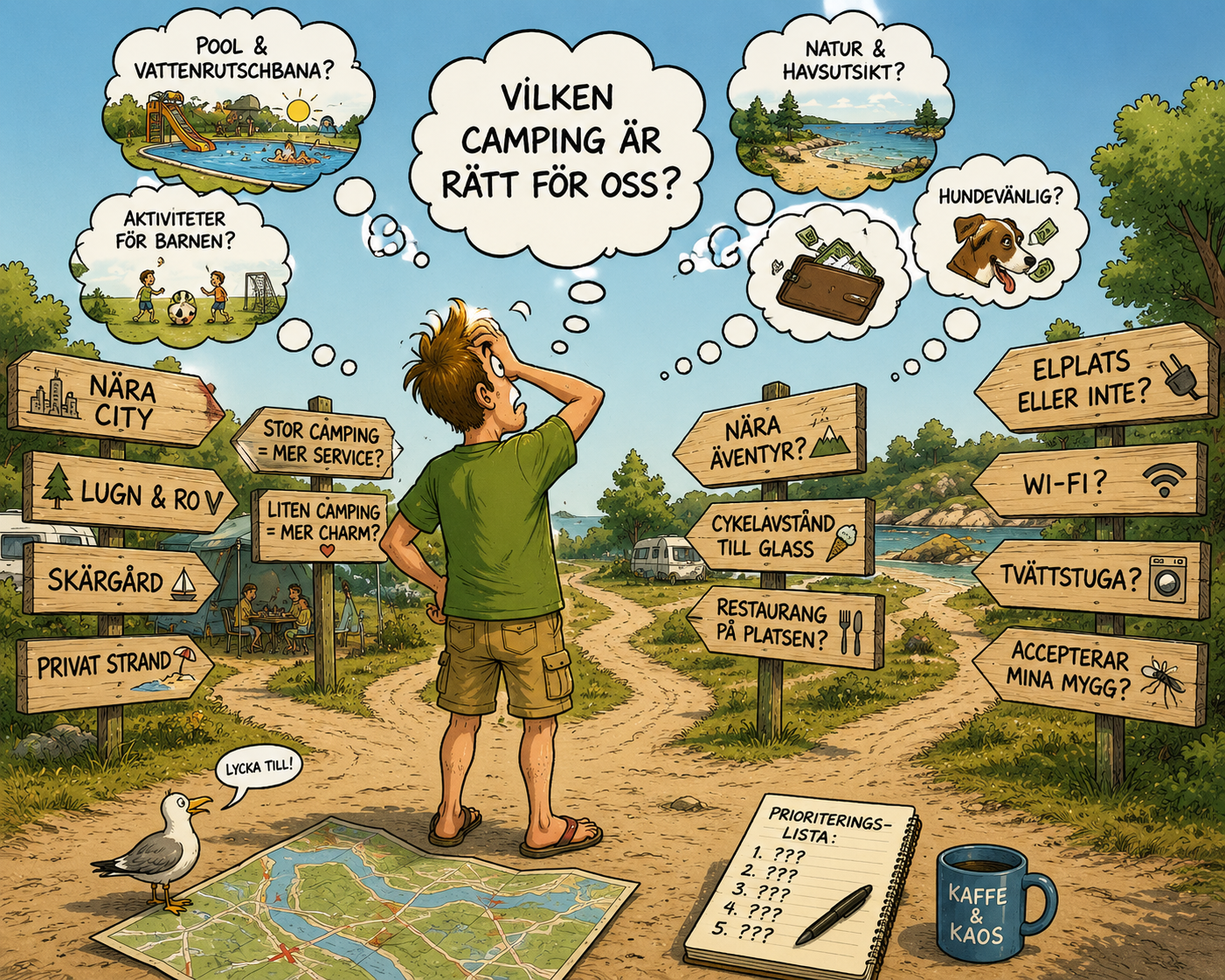
How to Choose a Campsite. Choosing a campsite may sound simple. Search the area, compare a few photos and book something that looks nice. But the best campsite is not always the biggest, cheapest or most central. The best campsite is the one that fits the trip you actually want to take.
Published: 7/21/2026 • By CampApp
Download the app here
Want to continue in CampApp? Download the app to save favourites, discover more campsites and get a better overall experience.


There is no best campsite for everyone
It is easy to start in the wrong place when choosing a campsite. You search for a destination, look at photos, compare star ratings and try to find the campsite that seems “best”. But camping rarely works that way.
The best campsite is not the one that suits everyone. It is the one that suits you, your travel companions and this particular trip.
A family with young children looking for a pool, playground and new friends needs something very different from an older couple hoping for peace, walking paths and a beautiful view. A dog owner will look for shade, good walking routes and dog-friendly swimming spots. A motorhome traveller may prioritise easy access, waste disposal and proximity to a town. A tent camper may care more about ground conditions, shelter from wind and distance to the service building.
So the question is not simply which campsite is best.
The question is which campsite is best for you this time.
Start with the holiday, not the campsite
Before comparing campsites, it is worth thinking about what the trip is actually supposed to be.
Is the campsite the destination, or is it mainly a base?
Those are two very different things.
If you plan to spend most of your holiday at the campsite, the site itself becomes much more important. Pool, beach, restaurant, playground, activities, pitch location and the general atmosphere all matter. This is where you will drink your morning coffee, cook dinner, let the children cycle around and settle into the evenings.
If the campsite is mainly a base for excursions, other things become more important. Location in relation to attractions, roads, public transport, parking and easy access may matter far more than whether the site has three playgrounds and evening entertainment.
A campsite where you plan to spend the whole week needs different qualities from a campsite where you mostly sleep between two days of exploring.
Choose based on who is travelling
One of the most common mistakes is choosing a campsite without really thinking about who will be staying there.
If you are travelling with small children, safety, swimming, play areas and other children nearby often make the biggest difference. It does not always need to be a huge activity programme. Sometimes a good playground, an open grassy area, safe cycling and a reasonable distance to the service building are enough.
If you are travelling with teenagers, the needs may look completely different. Swimming, Wi-Fi, mobile coverage, personal space, access to a town, activities or adventures nearby may matter far more than a playground they stopped caring about years ago.
If you bring a dog, it is not enough that the campsite “allows dogs”. Good walking routes, shade, clear rules and preferably a dog-friendly swimming area or somewhere to cool down can matter much more.
For adult couples or older campers, peace and quiet, views, good walks, clean facilities, a restaurant and proximity to nature or small towns may be more important than pools and children's activities.
And whether you travel by motorhome, caravan or tent also changes what matters. A motorhome often needs smooth logistics. A caravan needs a good pitch where you can set up properly. A tent needs good ground, shelter and reasonable access to facilities and cooking areas.
It may sound obvious, but it is easy to forget. A campsite can be excellent and still be wrong for your trip.
Peace and quiet or life and activity?
Another important question is how much activity you want around you.
A large family campsite or resort-style campsite can be perfect if you want a pool, ice cream, activities, restaurant and lots of other children around. For some families, that is exactly what makes the holiday easy. The children find friends, there is always something to do and the campsite almost becomes a small community of its own.
The same campsite may feel completely wrong for someone who wants to read a book, go fishing, take evening walks and sleep early.
That does not mean one type of campsite is better than the other. They simply suit different kinds of holidays.
Reviews can be useful here, but only if you read them through the right lens. If someone writes that there was “a lot going on”, that may be positive for a family with children and negative for a couple seeking calm. If someone describes the campsite as “very quiet”, that may sound perfect to some and boring to others.
Family-friendly and peaceful can sometimes be two different things. Both are good, but they do not always suit the same trip.
Location means different things
Everyone talks about location, but location does not mean the same thing to everyone.
For one person, a good location means being close to the town centre. For another, it means being close to the beach. Someone else wants hiking trails, cycle paths or nature reserves nearby. Another traveller wants to be close to the motorway because the campsite is only a stopover on the way somewhere else.
That is why “close” always needs a second question: close to what?
Do you want to walk to the beach in five minutes? Cycle into town? Have a grocery store nearby? Visit a theme park, a national park, the mountains, the coast or relatives?
Location is not just distance on a map. It is what you want to be able to do without turning it into a project.
Sometimes it may be better to stay a little outside the centre if that gives you the sea, nature and a calmer setting. Sometimes it is worth choosing a simpler campsite if it puts you closer to the activity that is the whole point of the trip.
It depends on what you want the holiday to be.
The pitch matters more than you think
Many people look closely at the campsite but hardly at the pitch itself. That is a mistake, because sometimes the difference between a good and bad camping experience is not the campsite but the pitch you end up on.
A sunny pitch can be wonderful in May and unbearable in July. A pitch next to the playground can be perfect with small children and quite intense if you want peace and quiet. Being close to the service building can be practical, but it may also mean more people passing by. A waterfront pitch can be beautiful but more exposed to wind.
Look at pitch size, surface, shade, electricity, distance to neighbours, room for an awning, distance to facilities and how the area appears to be laid out.
For caravans, slope and room for the awning can matter a lot. For tents, ground conditions can be crucial. For dog owners, shade may matter more than the view.
It is easy to think you just need “a pitch”. But when camping, the pitch is a big part of the holiday.
Facilities and stars do not say everything
Star ratings and classifications can be helpful. They tell you something about facilities, service and overall standard. But they cannot know what kind of holiday you want.
A simple campsite in a beautiful location with a calm atmosphere and good swimming can be perfect. A larger campsite with extensive facilities can also be perfect. More stars do not automatically mean a better holiday.
It depends on what you need.
Do you want a pool, restaurant, shop, activities, family bathrooms, laundry facilities, a good kitchen and plenty of service? Then a larger and better-equipped campsite may be worth it.
If you mostly want nature, quiet evenings, a swim at sunset and a place where morning coffee tastes good, a simpler campsite can be just as right.
Stars can help you understand the level of facilities.
They cannot decide what feels right for you.
Read the rules before they become a problem
Campsite rules may not be the most exciting holiday reading, but they can determine whether a place suits you.
Check arrival and departure times, quiet hours, dog rules, barbecue rules, vehicle traffic on site, number of people and vehicles per pitch, visitor rules and cancellation terms.
This is especially important if you travel with a dog, want to barbecue, arrive late, have a large vehicle or plan to stay close to nature or the beach.
Rules usually exist for a reason. They also help avoid surprises once the awning is already out and the children are on their way to the playground.
And if you are thinking about staying outside an official campsite, it is even more important to know the rules. Freedom to roam does not mean motorhomes and caravans can be parked anywhere. Parking or setting up in natural terrain is not the same as pitching a tent for one night, and local rules can vary.
The cheapest campsite is not always the cheapest holiday
Price matters, of course, but it is easy to compare the wrong things.
A cheap campsite can become expensive if you have to drive far every day to reach swimming areas, shops, activities and excursions. A more expensive campsite may be worth the price if the location, pool, service or activities make the holiday easier.
Look at what is included.
Electricity, showers, extra guests, dogs, pool access, activities, booking fees and cancellation terms can all affect the total. So can fuel, ferries, bridge tolls and parking costs in the area.
The cheapest campsite is not always the cheapest holiday.
Read reviews wisely
Reviews can be very useful, but they should be read with a bit of common sense.
Look for patterns rather than single extreme opinions. If many people mention clean facilities, friendly staff and a good location, that is usually a good sign. If several reviews mention noise, cramped pitches or poor cleaning, it may be worth taking seriously.
But remember that other guests may have had completely different expectations from yours.
Someone may give a low rating because the campsite lacked activities, while you think that sounds wonderful. Someone else may complain that there were many children, while a family with children sees that as a benefit.
Do not just read what people think.
Try to understand why they think it.
Quick checklist before booking
Before booking, it is worth asking a few simple questions.
Is the campsite the destination or just a base?
Who is travelling: children, teenagers, dogs, older relatives or friends?
Do you want peace and quiet or lots of activity?
Do you need a pool, swimming area, restaurant or activities?
How far is it to excursions, shops and attractions?
What are the pitches like in terms of size, shade, surface and electricity?
Are there good facilities, fresh water and waste disposal if you need them?
What are the rules for dogs, barbecues and quiet hours?
What are the cancellation terms?
What do reviews say about noise, cleanliness, location and hospitality?
It does not have to become a major investigation. But a few minutes with the right questions can make a big difference.
Choose the campsite for the holiday you actually want
There is no single right answer.
A resort-style campsite with a pool and activities can be exactly right. A small nature campsite by a lake can be exactly right. A practical motorhome stop close to town can be exactly right. A sandy beach campsite can be exactly right.
It all depends on what you want the trip to become.
It is easy to focus on pools, beaches, prices and star ratings. But sometimes it is the shade on the pitch, the walking distance to the service building or a good morning walk with the dog that determines how good the holiday feels.
Think of the campsite as more than a place to sleep.
When camping, where you stay is a big part of the journey.
And the best campsite is not always the one that looks best in the first photo.
It is the one that fits how you actually want to spend your holiday.
Read also
Let the Place Decide Dinner
Camping is all about freedom. The freedom to stop where the view is beautiful, take a detour when a handmade sign catches your eye or discover a small village you had never planned to visit. So why not let that same freedom shape your meals? Instead of planning every dinner before you leave home, let the place you're visiting decide what ends up on your plate.
Camping with Dogs: A Holiday for the Whole Pack
Camping is often one of the easiest ways to travel with a dog. You bring your own accommodation, spend plenty of time outdoors and often have nature close by. But a truly good dog-friendly holiday is not just about whether dogs are allowed. It is about finding places where both humans and dogs can actually enjoy themselves.
Camping with Teenagers: Let the Holiday Grow Up a Little
When children become teenagers, camping holidays change. The playground may no longer be enough, and yet another “cosy little outing” can be met with a look that says everything. But with more involvement, more flexibility and some respect for personal space, camping with teenagers can still be really good.