Camping Food on a Griddle: When the Whole Meal Fits on One Cooking Surface
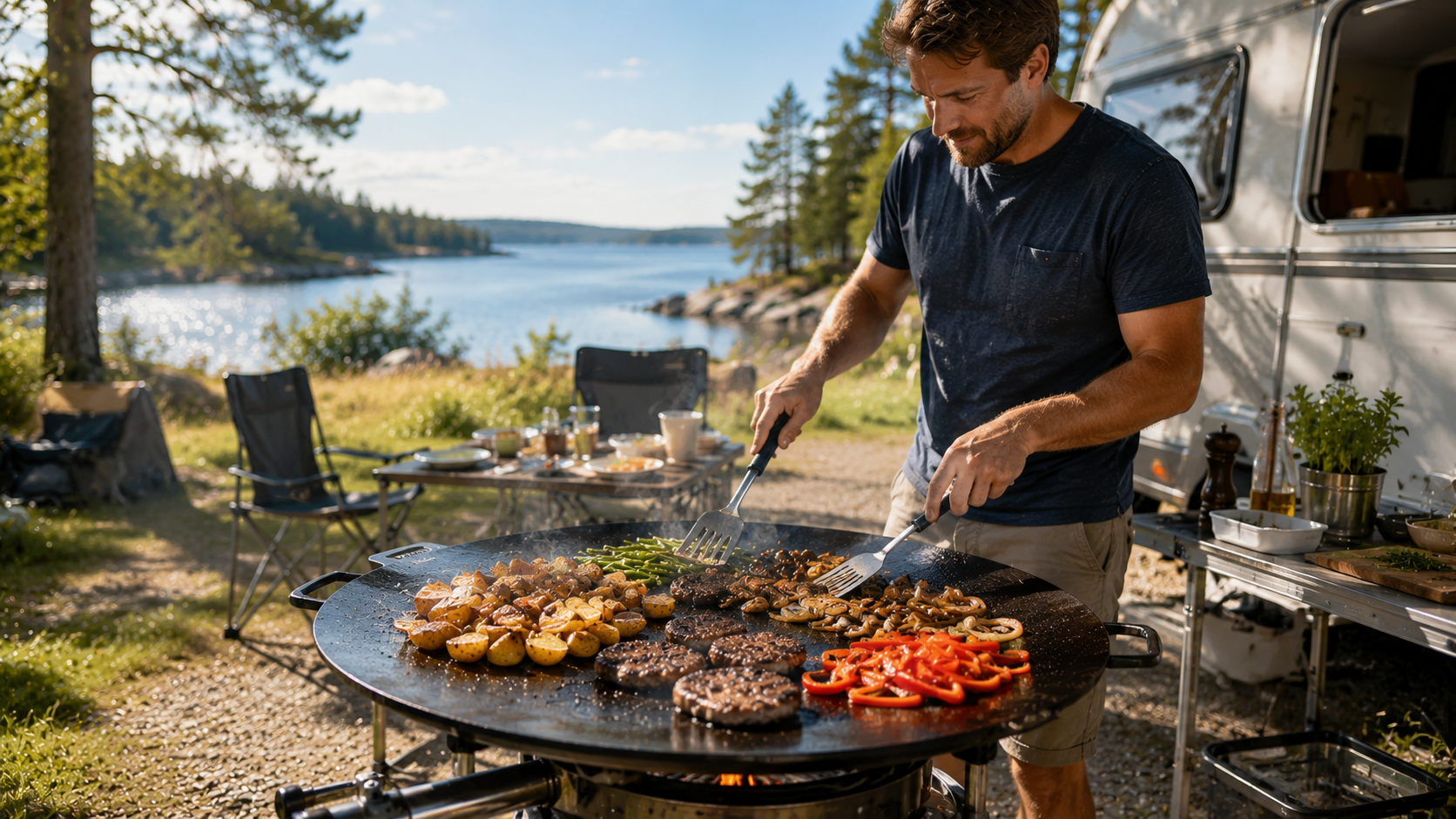
Camping Food on a Griddle: When the Whole Meal Fits on One Cooking Surface. There is something special about cooking outdoors while camping. It becomes even better when breakfast, lunch and dinner can all be prepared on the same large griddle. It expands the campsite kitchen, rescues leftovers from the fridge and turns a few simple ingredients into a meal that feels far more satisfying than another dry sausage from the barbecue.
Published: 8/7/2026 • By CampApp
Download the app here
Want to continue in CampApp? Download the app to save favourites, discover more campsites and get a better overall experience.


Your own outdoor campsite kitchen
It often begins innocently enough. You buy a large outdoor griddle to make hash or cook a few burgers outside the caravan. Before long, breakfast eggs, pancakes, vegetables, fish and leftovers from yesterday's barbecue are all being cooked on it too.
It is easy to understand why large outdoor griddles have become popular among campers. The cooking surface allows you to prepare food for the whole family without creating a queue beside one small frying pan on the gas hob. Meat can brown in the centre, vegetables can cook on one side and finished food can stay warm near the edge. You may still be standing beside the caravan in sandals, but it feels much closer to having a real outdoor kitchen.
Muurikka is technically a brand name, although in Scandinavia it is often used as a general word for this type of griddle. Whatever you call it, the principle is the same: a large, slightly curved steel surface used over a gas burner or open fire that can cook far more than sausages.
The food does not need to be complicated. In fact, the griddle is at its best with meals that can handle a little creativity, slightly chaotic planning and different parts of dinner being ready in different corners at the same time.
Leftovers return with confidence
A griddle may be at its most useful the day after another meal. The fridge contains a bowl of boiled potatoes, half an onion, a few pieces of chicken, three sausages and a container of vegetables whose original purpose has been forgotten.
In an ordinary kitchen, they may look like uninspiring leftovers. On the griddle, they become a proper hash.
Cooked rice can become fried rice with eggs, vegetables and soy sauce. Taco leftovers can go into quesadillas. Grilled chicken becomes filling for wraps. Potatoes, bacon and onions can cook together and be topped with fried eggs. Even instant noodles can be improved with vegetables, leftover meat and whatever sauce happens to be in the fridge door.
The griddle is the refrigerator clear-out's best friend. What looked like three sad containers of leftovers suddenly has crisp edges, proper colour and far more confidence.
That is particularly useful when camping, where refrigerator space is limited and nobody wants to return home with a collection of half-empty packages that have travelled across the country.
Breakfast can quickly get out of hand
Breakfast on a griddle is dangerously enjoyable. It may begin with eggs and bacon, but once the surface is hot, somebody wants to toast bread. Then the tomatoes go on. Someone finds halloumi in the fridge and a child asks whether pancakes would be possible too.
Suddenly, the entire breakfast is being cooked outside.
Eggs and bacon are the obvious classics, but fried bread, American pancakes, omelettes, toasted sandwiches and breakfast hash made from yesterday's potatoes work just as well. With enough room, different members of the family can have what they want without requiring four frying pans.
The social element is a large part of the appeal. People gather around the cooking surface, comment, taste and offer to help. Occasionally it becomes too social, with five people standing around the same piece of onion and expressing different opinions about whether it is ready.
That is part of camping too. Cooking is allowed to take time and become part of the day.
Meals the whole family can enjoy
For families, smash burgers are an almost unfairly reliable option. Minced beef, cheese, buns, pickles and dressing require little preparation, while the hot surface creates the crust that is difficult to achieve on a normal barbecue. Onions can cook beside the meat and buns can warm around the edge.
Quesadillas are another easy choice. Fill tortillas with cheese and whatever is available, cook them on both sides and cut them into wedges. They are quick, create very little washing up and work well for lunch or a simple dinner.
Fried rice is perfect when cooked rice remains from the previous day. Fry vegetables, chicken, sausage or tofu, move them aside and scramble a few eggs. Add the rice and soy sauce, keeping part of the meal mild before adding chilli or stronger sauces.
Pancakes are always welcome, and the large surface means you do not need to cook one at a time while the rest of the family finishes eating before the cook has even started.
For something more substantial, potato pancakes with bacon are ideal for a griddle. The same applies to hash, kebab-style meat and vegetables, stir-fries, fried gnocchi or sausage and potatoes.
The important thing is not to overcomplicate the meal. Camping food can be very good without containing twenty ingredients and three sauces that require a full-sized kitchen counter.
Let dinner taste of the destination
A griddle also pairs perfectly with farm shops, fish smokehouses and local producers. Buy whatever looks best, cut it into suitable pieces and let the hot surface do the rest.
Fresh potatoes from a roadside stall can cook with local sausage, onion and peppers. Smoked fish can be served with potatoes, asparagus and a cold sauce. Eggs from a farm shop can become an omelette or top the evening hash. Halloumi or local cheese can be fried with courgette, tomatoes and other vegetables.
Near the coast, fish fillets with butter, lemon, dill and fresh potatoes can feel almost luxurious despite being very simple to prepare. In areas known for game, sliced venison with onions and mushrooms can become a hearty meal directly on the griddle.
A farm shop and a griddle are a perfect holiday combination. You do not need to know exactly what dinner will be before leaving the campsite. You only need to find a few good ingredients and be willing to change the plan.
Think in zones, not frying pans
A griddle does not work exactly like a normal frying pan. The centre is often hottest, while the outer area has a lower temperature. That is not a flaw. It is one of the main advantages.
Use the centre for hard searing. Meat, burgers and potatoes develop good colour there. Move food outwards when it is cooked and only needs to stay warm. Vegetables can have their own section, while bread and tortillas warm at the edge.
Think of it as a small cooking arena rather than a very large frying pan.
Always begin with whatever takes longest. Raw potatoes, root vegetables and onions need to go on early. Eggs, cheese, bread and fresh vegetables can wait until the end. If everything is added at once, half the food may become cold while the potatoes remain hard.
It is also useful to keep part of the surface mild if children are eating. Once their portions are ready, chilli, strong sauces, garlic and other flavours can be added to the rest.
Prepare more than you think
Griddle cooking looks spontaneous, but a little preparation makes a big difference. Anyone who has tried chopping every onion beside the griddle in a strong crosswind quickly understands why mise en place was invented.
Wash, peel and cut vegetables inside the caravan before lighting the burner. Mix pancake batter, shape burgers and measure sauces in advance. Place ingredients in bowls or containers so they can be carried outside and added in the correct order.
This does not mean the meal must be planned in minute detail. But once the griddle is hot, things can happen quickly, and it is better not to run inside looking for salt while the onions turn black.
Start before everyone is desperately hungry too. Heating the surface, chopping and cooking several elements can take longer than expected, especially when dinner has been described as something that will “just be thrown together”.
Oil, heat and a sensible amount of food
A new or poorly seasoned griddle needs more fat than many people expect. Too little oil causes food to stick and soon somebody is scraping at the surface in panic.
Rapeseed oil is practical because it tolerates high heat. Butter adds flavour but burns more easily, so it often works best towards the end or together with oil.
Do not overload the surface either. A large griddle does not mean the entire refrigerator should be emptied onto it at once. Frozen ingredients and large quantities of vegetables release a lot of water, causing food to steam rather than fry.
Cook in batches and use the edges for finished food. This is often faster than waiting for a small inland sea of vegetable water to evaporate.
Wind, flames and campsite neighbours
Outdoor cooking requires more thought than using the stove at home. Wind affects both the flame and the distribution of heat. Position the equipment somewhere sheltered but never so close to an awning, tent fabric, dry grass or other combustible materials that heat becomes dangerous.
The burner, hose and gas connections must be in good condition, and the griddle needs to stand securely. Children and dogs should be kept away from the hot surface and from hoses, tools and equipment that create a tripping hazard.
The griddle may be social, but it does not need to stand directly in the main walkway simply because everyone wants to join in.
Think about smoke and cooking smells as well. It is nice when the neighbours think dinner smells good. It is less pleasant when their awning fills with smoke because the wind changed direction.
Clean it while it is still warm
After the meal, it is tempting to put away the tools and decide that cleaning can happen later. Later, it is dark, cold and the griddle has become a burnt archaeological excavation.
Clean it while it is still warm. Scrape away food residue, add a little water and allow it to boil. Scrape or brush the surface clean, dry it thoroughly and apply a thin layer of oil when needed.
A seasoned steel griddle should not normally be washed like a saucepan with detergent after every use, as detergent can strip away the protective oil layer. A new griddle should be cleaned and seasoned according to the manufacturer's instructions before its first proper use.
The griddle does not want to be washed. It wants to be scraped, boiled clean, dried and given a little oil as thanks for its work.
Make sure it is completely dry before storing it. Rust and camping holidays are an unnecessarily disappointing combination.
Griddle or barbecue?
The barbecue and the griddle are not really rivals. They are good at different things.
A barbecue is difficult to beat when meat, chicken, sausages, skewers or corn need grill marks and smoky flavour. It is simple and natural when ingredients can remain in one place and cook over direct heat.
A griddle is better when food needs to be moved, mixed and cooked together. Breakfast, hash, rice, noodles, fish, pancakes, burgers and leftovers often work better there. It is also superior when dinner would otherwise require three frying pans and a much better campsite kitchen than you actually have.
The barbecue is king of things that need grilling.
The griddle is king of turning whatever you have into dinner.
Begin with hash and let the rest follow
Anyone new to griddle cooking does not need to begin with paella for twelve people or a complicated stir-fry where seventeen ingredients must be added at exactly the correct moment.
Begin with hash.
Boiled potatoes, onions, sausage, bacon, chicken or halloumi. Fry until everything has good colour, add a few eggs and serve with mustard, mayonnaise, yoghurt or whatever is available in the fridge.
Next time, make smash burgers. Then fried rice. After a few trips, you may find yourself cooking fish, fresh potatoes and asparagus bought from a nearby farm shop and wondering why you ever accepted a single saucepan on the campsite stove.
That may be the griddle's greatest strength.
It does not only make the food easier.
It allows cooking to become part of camping life, complete with delicious smells, unsolicited opinions, sandals and somebody who always presses the burger slightly too early.
Read also
Camping with Teenagers: Let the Holiday Grow Up a Little
When children become teenagers, camping holidays change. The playground may no longer be enough, and yet another “cosy little outing” can be met with a look that says everything. But with more involvement, more flexibility and some respect for personal space, camping with teenagers can still be really good.
First Time in a Motorhome: Does Everything Really Have to Be Level?
A first motorhome trip is often a mixture of freedom, excitement and mild panic. You imagine drinking coffee beside a peaceful lake, but soon find yourself at a motorhome stop wondering whether the vehicle is leaning, how to empty the grey water and why the power cable is two metres too short. Relax. You do not need to know everything, buy everything or park perfectly level on your first attempt.
The History of the Caravan – How a Home on Wheels Became Part of Scandinavian Life
A caravan is much more than just a vehicle. For many people, it is a holiday cottage on wheels, a place where the holiday begins the moment it is hitched to the car. But where did it all start? From exclusive horse-drawn touring wagons to becoming a symbol of freedom, family holidays and the Scandinavian love of both adventure and comfort, the caravan has travelled a remarkable journey.