Rooftop Tents: Freedom Above the Car, but Check the Weight First
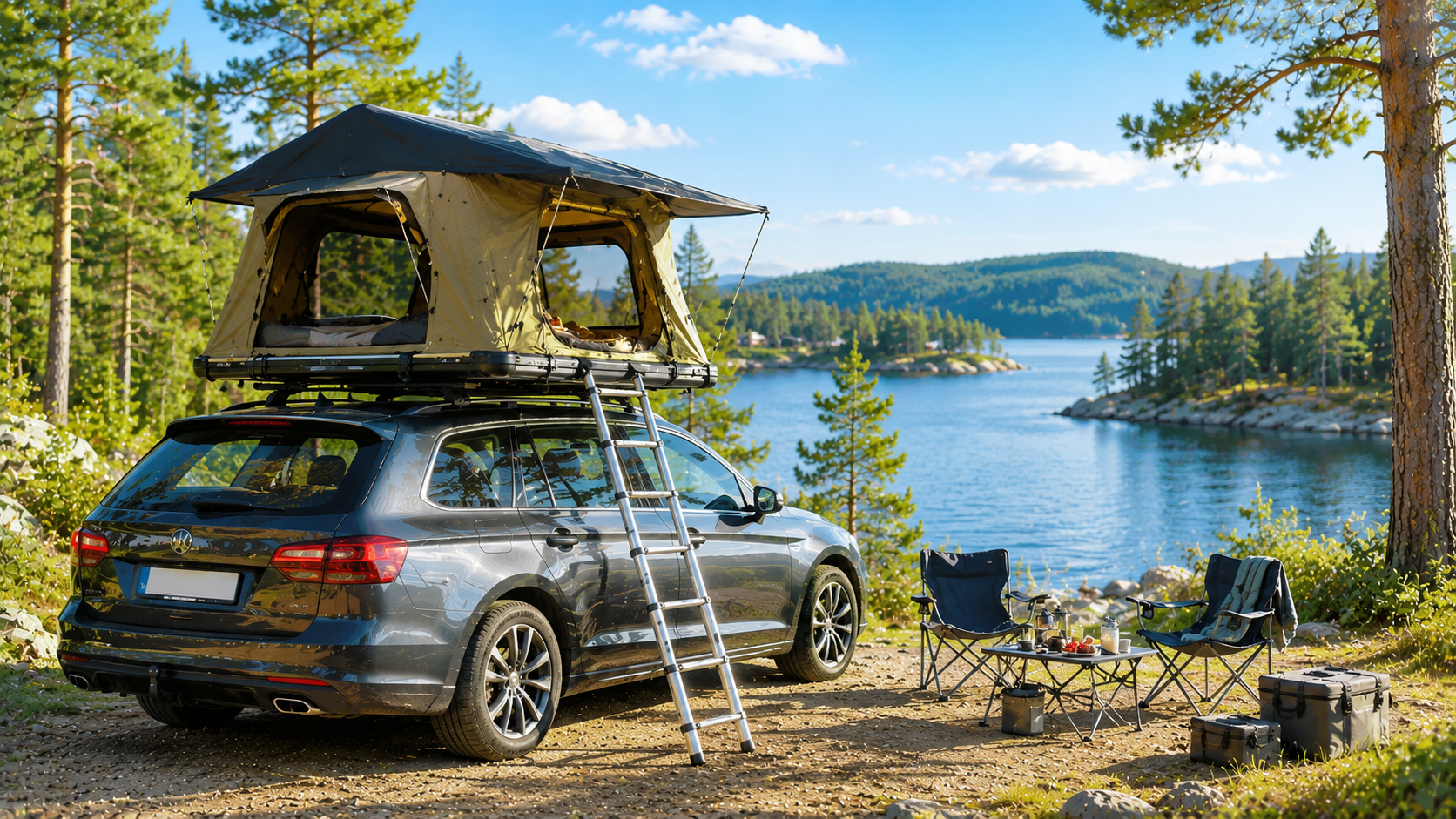
Rooftop Tents: Freedom Above the Car, but Check the Weight First. Rooftop tents look almost ridiculously simple. Park the car, open the tent and suddenly you have a bedroom with a view. No caravan, no motorhome and no ground tent on uneven soil. But behind the adventure comes roof load, extra height, wind resistance, ladders, condensation and rules that are easy to misunderstand. A rooftop tent can be brilliant, but it is still camping and sometimes rather more complicated than the photographs suggest.
Published: 8/12/2026 • By CampApp
Download the app here
Want to continue in CampApp? Download the app to save favourites, discover more campsites and get a better overall experience.


An old idea in modern packaging
Rooftop tents feel very modern. They appear on overland vehicles, SUVs and estate cars fitted with dark roof bars, additional lights and the general impression that the owner could leave for Mongolia at any moment.
The idea, however, is far from new.
Early production rooftop tents appeared during the 1950s, particularly in Italy. Since then, they have been used on expeditions, safaris and long-distance journeys, long before they became a familiar sight on ordinary campsites and at trailhead car parks.
What has changed is accessibility. Rooftop tents are now available for everything from smaller passenger cars to large four-wheel-drive vehicles. You no longer need to plan a journey across the Sahara to justify owning one. A weekend by the coast or a road trip through Scandinavia is more than enough.
The basic idea remains the same. Your sleeping space travels with the vehicle and opens wherever the vehicle may legally stand.
Why rooftop tents are so appealing
The attraction is easy to understand.
You do not need to find perfectly flat ground, remove stones or force tent pegs into soil that seems to be made from reinforced concrete. The mattress is already inside and your sleeping area is raised above wet ground, mud and at least some insects.
Hard-shell tents in particular can be very quick to open. Release the catches, lift the shell and the bedroom is ready within minutes. Soft-shell tents often require more work but may provide a larger sleeping area and a more traditional tent experience.
There is also something emotional about climbing onto the roof and closing the fabric behind you. Even an ordinary campsite can feel more adventurous when you sleep two metres above the ground.
A rooftop tent sits somewhere between a ground tent and a camping vehicle. It offers more comfort than sleeping on the ground, while remaining far simpler and less expensive than a caravan or motorhome.
It is still a tent
That is worth remembering before buying one.
A rooftop tent may have a thick mattress, good ventilation and a hard shell that opens in seconds. It is still a tent. Wind makes noise. Rain can be loud. Condensation appears. Fabric needs to dry and a cold night remains a cold night.
You also do not have standing height, an indoor kitchen, a toilet or the same protection from weather offered by a caravan or motorhome. After several wet days, the romantic idea of simple outdoor living can turn into wet shoes, damp jackets and a car being used as hallway, wardrobe and kitchen at the same time.
This does not make rooftop tents bad. It simply means you should buy one for what it really is, rather than what the promotional photographs promise.
A rooftop tent is not a small caravan on the roof.
It is tent camping, only higher and usually a little more comfortable.
Weight matters more than the adventure image
The most important question before buying is not the colour, mattress thickness or opening time.
It is the weight.
The tent sits on the vehicle's roof while driving. The vehicle, roof bars and mounting system must therefore all be approved for the load. Check the vehicle's maximum permitted roof load, the roof rack's capacity and the tent's own weight.
It is not enough to assume that the roof can support two adults while parked. First, the car and rack must support the tent while moving. This is often described as the dynamic load. When the vehicle is parked and people are sleeping inside, the load becomes static, but the entire system must still be designed for it.
Do not guess and do not rely on general rules from internet forums. Check the vehicle handbook, rack specifications and the rooftop tent manufacturer's instructions.
Count the whole system too. Tent, roof bars, mattress, ladder and any equipment the manufacturer allows to remain inside during transport.
Do not forget the vehicle's overall payload either. A rooftop tent can weigh a significant amount and affects not only the roof but how much other equipment the car may legally carry.
The car will feel different
The weight is positioned high on the vehicle.
This affects the centre of gravity and may be noticeable in corners, crosswinds and sudden manoeuvres. Even when the load is within the permitted limits, the vehicle may feel different from before.
The rooftop tent also increases aerodynamic drag. This may lead to higher fuel consumption, additional wind noise and more sensitivity to strong winds. The effect depends on the car, tent model, speed and installation, but it can be noticeable.
The vehicle also becomes taller.
It is easy to feel free with a rooftop tent until you approach a multi-storey car park, automatic car wash or low branch and suddenly begin trying to remember the exact height of the whole setup.
Measure the vehicle's total height with the tent installed and keep the figure easy to find. It is a small detail that can save the tent, roof and your pride.
The ladder is both charm and everyday reality
Sleeping on the roof means climbing up to it.
For many people, the ladder is part of the appeal. You climb up, gain a view and feel rather more adventurous than when crawling into a ground tent.
But the ladder also needs to work in rain, darkness and at 3:17 in the morning when somebody needs the toilet.
It may be awkward with small children, dogs, stiff knees or reduced mobility. Shoes need somewhere to go, phones should preferably not be dropped and night-time toilet trips become more of a project than they would be in a caravan.
For two adults comfortable with ladders, this may not be a problem at all. For a family with young children or a large dog, it may be decisive.
Testing a rooftop tent before buying is therefore a very good idea. Something that appears effortless at an exhibition can feel quite different when the whole family needs to climb up and down several times each day.
The bedroom must be packed away whenever you need the car
This is one of the biggest practical disadvantages of rooftop tents.
When the tent is open, the vehicle is effectively fixed in place. If you want to drive to a shop, beach or attraction, the bedding and equipment must be organised and the tent folded away again.
It is convenient when travelling from place to place and using the car mainly for the journey. It is less convenient if you want to stay three nights at the same campsite and use the car several times each day.
Rooftop tents therefore work especially well for short stops, road trips and journeys where you already expect to pack up each morning. For longer stays, bicycles can be useful, or a ground tent, camper conversion or caravan may be more practical.
It is an important question to ask before buying:
Do you want to move on almost every day, or build a camp and use the car for other things?
The answer says a great deal about whether a rooftop tent will suit you.
Public access rights do not turn the car into a tent
Rooftop tents are often associated with freedom and wild camping. Promotional images show a vehicle alone beside a lake, on a beach or in a forest clearing.
In Sweden, the rules are considerably less romantic.
A vehicle with a rooftop tent follows the rules for vehicles, not the rules for an ordinary tent. Public access rights do not allow you to drive into natural terrain and set up a car with a rooftop tent. Most natural ground away from roads is legally considered terrain, including beaches, pasture, forests, parks and grassland.
You cannot simply drive into nature and claim that you are tent camping.
Use campsites, legal parking or rest areas where overnight stays are permitted, organised motorhome areas and other places where the vehicle is allowed to remain. Private land may sometimes be an option when parking is legal and the necessary permissions exist, but landowner approval does not automatically override off-road driving rules.
The tent is attached to the car.
It therefore follows the car's restrictions, however adventurous the bedroom may look.
Hard shell or soft shell?
The two main categories are hard-shell and soft-shell tents.
Hard-shell tents are often quicker to open and close. They may offer better aerodynamics, feel robust and work well for journeys with frequent overnight stops. They are usually more expensive and may provide less sleeping space for their price and weight.
Soft-shell tents normally fold out to the side and can provide a larger sleeping platform. They are often less expensive, and some models support annexes or covered areas. On the other hand, they involve more fabric, more steps and more work when packing everything away in wind and rain.
In simple terms, a hard shell is often closer to open and sleep, while a soft shell is more like traditional camping, only on the roof.
The best option depends on how often you expect to move, how many people need to sleep and how much work you accept at each stop.
Installation and storage are easy to overlook
A rooftop tent is not always something one person can casually lift off the car after the weekend.
Many models are heavy and require two or more people to install. Some owners use ceiling hoists in garages or dedicated storage frames. The tent also needs dry storage when it is not in use.
Leaving it on the vehicle all season affects daily driving, fuel consumption, height and possibly access to a garage. Removing it between trips requires a sensible lifting and storage solution.
Do not only consider how the tent works during the holiday.
Consider where it will live during the rest of the year.
Who is a rooftop tent best for?
Rooftop tents often work very well for one or two adults who want to travel simply and remain mobile. They can be excellent for weekend trips, road trips, festivals, short nature breaks and campers who want more comfort than a ground tent without buying a separate leisure vehicle.
They may also suit people whose car cannot tow a heavy trailer or who simply do not want a caravan.
They are less suitable for anyone needing standing height, a toilet, extensive storage or strong protection during long periods of bad weather. Small children, large dogs, difficulty using ladders or the need to drive several times each day may also make a rooftop tent less practical.
It is not about rooftop tents being better or worse than other options.
It is about the kind of camping life you want.
Test it close to home first
Your first journey does not need to be eight hundred kilometres away in sideways rain.
Install the tent at home, open and close it several times and check every mounting point. Spend a night on the driveway or at a campsite close to home. Test the ladder, work out where shoes belong, decide where phones and glasses will be stored and discover how often you need to climb up and down.
Drive a reasonable distance with the tent installed and listen for wind noise. Notice how the car behaves and monitor fuel consumption. Check bolts and fittings after the first journeys according to the manufacturer's instructions.
The best rooftop-tent debut is not the most spectacular one.
It is the one where you learn how everything works and can still laugh when somebody realises their toothbrush is in the car after everyone has climbed into bed.
Freedom, but not without inconvenience
A rooftop tent can provide a wonderful feeling of freedom.
You can travel in an ordinary car, avoid towing and still have a proper mattress and a sleeping area less dependent on the ground. It is perfect for certain types of journeys and can make an ordinary weekend feel considerably more adventurous.
But it is not the completely effortless solution that the photographs sometimes suggest.
The tent has weight. The car becomes taller. The bedroom must be packed away whenever the vehicle is needed. The ladder still exists in the middle of the night, and public access rights do not allow the vehicle to stand anywhere you please.
Check the roof load, racks and rules. Think about how often the car will be needed during the stay and whether everybody travelling genuinely likes the idea of a ladder.
Do that, and a rooftop tent can be an excellent way to camp.
Not because it removes every inconvenience.
But because it keeps the inconvenience small enough for the freedom to feel larger.
Related links
Read also
Let the Place Decide Dinner
Camping is all about freedom. The freedom to stop where the view is beautiful, take a detour when a handmade sign catches your eye or discover a small village you had never planned to visit. So why not let that same freedom shape your meals? Instead of planning every dinner before you leave home, let the place you're visiting decide what ends up on your plate.
Camping with Dogs: A Holiday for the Whole Pack
Camping is often one of the easiest ways to travel with a dog. You bring your own accommodation, spend plenty of time outdoors and often have nature close by. But a truly good dog-friendly holiday is not just about whether dogs are allowed. It is about finding places where both humans and dogs can actually enjoy themselves.
Camping with Teenagers: Let the Holiday Grow Up a Little
When children become teenagers, camping holidays change. The playground may no longer be enough, and yet another “cosy little outing” can be met with a look that says everything. But with more involvement, more flexibility and some respect for personal space, camping with teenagers can still be really good.